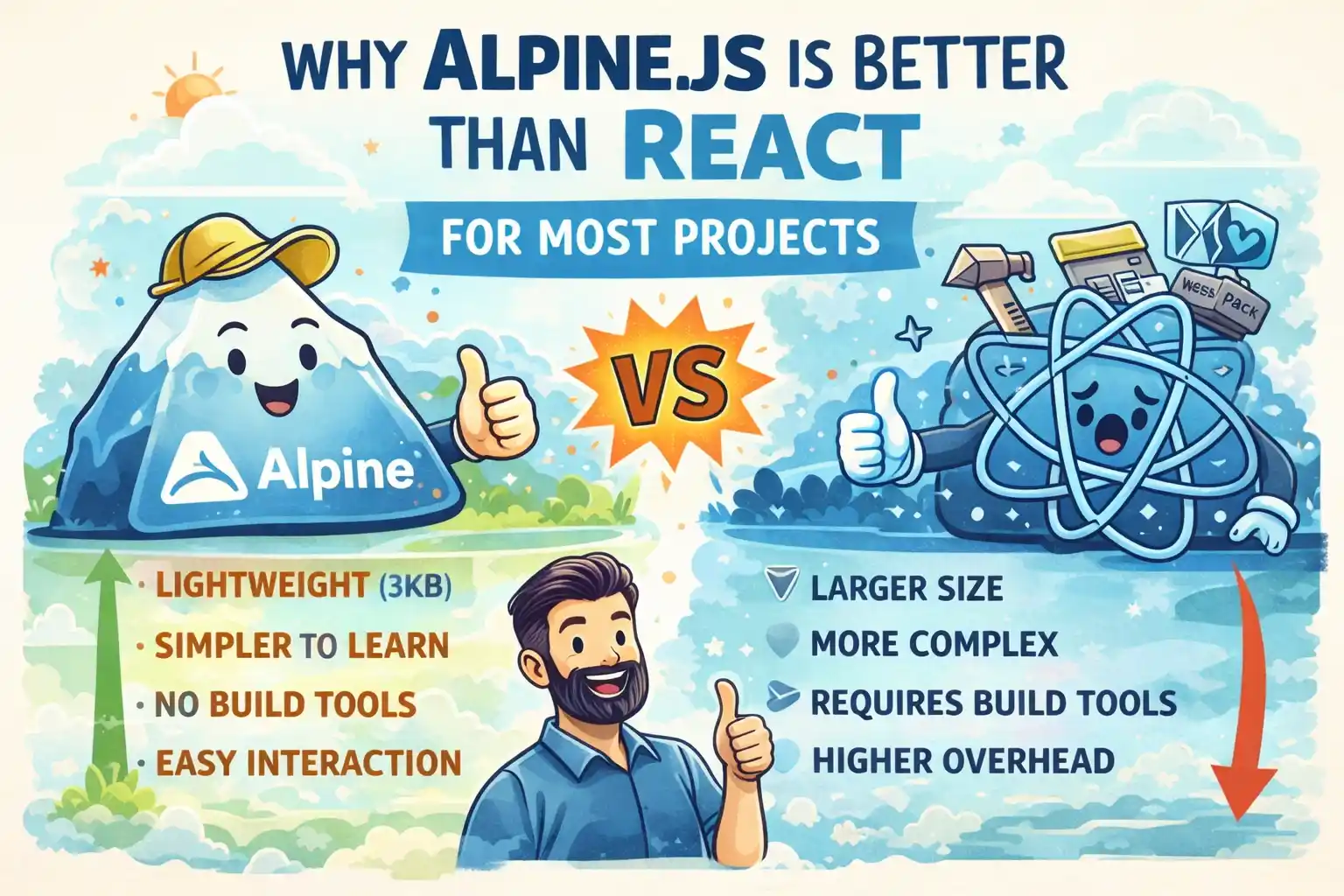
The React Trap
React is everywhere. Every job posting wants React. Every bootcamp teaches React. Every developer thinks they need React.
But most projects don't need React. They need something simpler. Something that doesn't require build tools, npm packages, and constant configuration. They need Alpine.js.
What is Alpine.js?
Alpine.js is a lightweight JavaScript framework. 15KB minified. No build step. No virtual DOM. Just HTML attributes that add interactivity.
It looks like this:
<div x-data="{ open: false }">
    <button @click="open = !open">Toggle</button>
    <div x-show="open">Content here</div>
</div>
That's it. No compilation. No JSX. No webpack. Just HTML with sprinkles of JavaScript.
No Build Step Required
React requires a build pipeline. Install Node. Set up webpack or Vite. Configure Babel. Wait for compilation. Watch for file changes. Debug build errors.
Alpine.js requires a CDN link. One line in your HTML. You're done. Write code. Refresh browser. It works.
This difference matters enormously. Build steps slow development. They complicate deployment. They break randomly. Alpine.js eliminates all of this.
Learn in Minutes, Not Weeks
React has a steep learning curve. JSX syntax. Component lifecycle. Hooks. State management. useEffect dependencies. Prop drilling. Context API. The list continues.
Alpine.js has about 15 directives. x-data, x-show, x-if, x-for, x-on, x-model. Learn them in an afternoon. Build real features immediately.
New developers understand Alpine.js code instantly. It's just HTML with extra attributes. No mental gymnastics required.
Perfect for Server-Side Frameworks
We build with Django and Laravel. These frameworks render HTML server-side. Alpine.js fits perfectly. Add interactivity where needed without fighting the framework.
React wants to own the entire frontend. It fights server-side rendering. You end up with complex hydration issues and separate API layers you didn't need.
Alpine.js enhances server-rendered HTML. Dropdowns work. Modals open. Forms validate. But the server still controls routing and rendering.
Size Matters
React is 42KB minified and gzipped. React DOM adds another 130KB. React Router? More kilobytes. Redux? Even more.
Alpine.js is 15KB total. Your entire JavaScript framework weighs less than a medium-sized image. Page loads stay fast.
For mobile users on slow connections, this difference is massive. Alpine.js sites load instantly. React sites show loading spinners.
When React Actually Makes Sense
React isn't bad. It's just overused. React makes sense for:
- Complex single-page applications
- Heavy client-side state management
- Real-time collaborative editing
- Dashboard-heavy applications
- When you actually need a virtual DOM
But most projects aren't building these things. Most projects need forms with validation. Dropdowns that open. Tabs that switch. Modals that appear. Alpine.js handles all of this perfectly.
The Job Market Argument
People learn React because jobs require React. But this is circular reasoning. Jobs require React because everyone learns React.
Good developers learn tools as needed. Adding Alpine.js to your stack takes a day. Companies hiring good developers understand this. Optimize for building good software, not collecting buzzwords.
Maintenance is Simpler
React applications age poorly. Dependencies break. Packages deprecate. Major version updates require rewrites. Build configurations stop working.
Alpine.js is stable. Version 3 has been solid for years. No breaking changes every six months. Code written today will work in five years.
Real Projects, Real Results
We've built production applications with Alpine.js. E-commerce stores. Booking systems. Dashboards. User interfaces for complex applications.
Development is faster. Code is clearer. Bugs are fewer. Performance is better. Clients are happy.
None of these projects needed React. They needed interactivity without complexity. Alpine.js delivered exactly that.
The Pragmatic Choice
Stop reaching for React automatically. Ask if your project actually needs it. Most projects need Alpine.js instead.
Save React for projects that genuinely require heavy client-side complexity. Use Alpine.js for everything else. Ship faster. Maintain easier. Build better software.